
LEARNING & DEVELOPMENT



Intent
At St Columba’s, our Geography curriculum aims to motivate, inspire and challenge pupils through the experiences we provide. We aim to develop a curiosity and fascination about the world that children live in as they learn about global and local communities. Through our curriculum, we aim to equip children to become Global Citizens as they develop an awareness of the wider world and their place within it.
Our Geography curriculum is designed to deepen knowledge and develop key skills. We aim to ensure effective progression within each Geography unit and across all year groups. The curriculum has been carefully tailored with the intention that it is age appropriate, meaningful and engaging for all of our learners and cross-curricular links can be made to further develop pupils’ Geography awareness.
We aim for our learners to develop a deep understanding of place, locational, human and physical knowledge of the local area, the United Kingdom, regions within Europe and the wider world. We aim to provide a variety of carefully planned fieldwork and mapping opportunities so that pupils are able to develop and apply their own Geography skills through real life and purposeful opportunities.
Implementation
In Geography, we implement an inclusive curriculum that meets the statutory requirements of the National Curriculum, incorporating the four main areas of learning at each key stage: place, location, human and physical and geographical skills and fieldwork. Our curriculum is well-planned and provides literacy-rich, cross-curricular opportunities across subjects.
Our curriculum has been created to develop and build on prior learning. Pupils will revisit previous learning through ‘can you still’ tasks, retrieval activities and quizzes. Learning from previous Geography units is revisited during the teaching of new concepts so that pupils are able to make connections and they have opportunities to apply their sticky knowledge to other areas of Geography. In books, pupils have knowledge organisers for each unit which are filled with sticky knowledge, relevant vocabulary and key questions. Our Geography curriculum promotes children’s Spiritual, Moral, Social and Cultural development, ensuring that they are reflective and responsible citizens. Fundamental British Values are actively promoted in geography lessons in order to prepare the children for life in Modern Britain.
Our curriculum has been designed to be ‘personal’ to St Columba’s so that pupils are able to develop their mapping and fieldwork skills through high quality experiences within the local area or on the school grounds. These experiences include a fieldwork trip to the local river, road traffic surveys and orienteering. The curriculum is delivered through highly effective teaching using a range of schemes and resources. Enrichment opportunities, including outdoor learning, inspirational visitors and Geography fieldtrips, provide our children with rich experiences and enhance teaching, learning and knowledge.
At the end of each unit a ‘knowledge’ based assessment task is completed by pupils. These tasks have been designed to provide children with opportunities to demonstrate progress and understanding. Teachers based judgements are used to assess pupil’s knowledge and skills understanding in Geography. They use topic overviews and end points to make their judgements. These results are then recorded on a whole school tracking system.
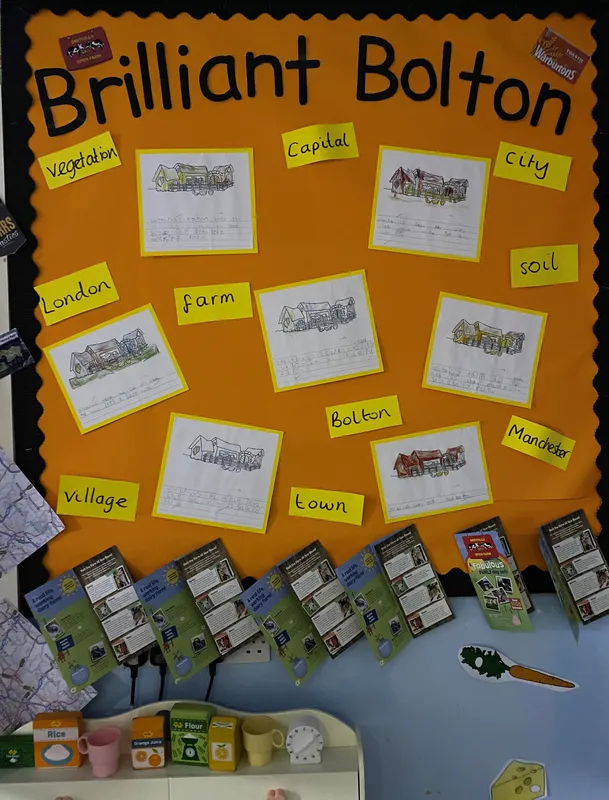
In the Early Years Foundation stage (Nursery and Reception), pupils are provided with opportunities to develop a range of highly transferable skills values and attributes, including: problem-solving, observation, collaboration, open-mindedness, courage, resilience, curiosity, integrity, and a sense of what is fair and equitable. These combine to allow them to explore, interpret and ‘experience’ the world around them, as well as providing the foundations on which all future learning can be built. Of the seven areas of learning and development outlined in the EYFS framework the one that fits best with geography is undoubtedly: ‘Understanding the World’. At St Columba’s, children in Nursery and Reception are guided to make sense of their physical world and community through a range of personal experiences. You can find out more about how we develop pupils’ Geography skills in EYFS below.
Impact
Our well-planned Geography curriculum ensures that children are competent in the geographical skills needed to collect, analyse and communicate data, and to interpret a range of geographical sources, including maps, globes and aerial photographs. Children are able to communicate information in a variety of ways including maps, numerical and quantitative skills and a range of literacy skills. Through the breadth and depth that our Geography curriculum offers, our children are provided with a broad knowledge of the world they live in, and understand, as responsible citizens, how they need to care and preserve the planet for future generations.
How will pupils develop their Geography skills whilst in the Early Years Foundation Stage at St Columba’s?
Through continuous provision and focused learning tasks throughout the year, pupils will:
- Select, rotate and manipulate shapes in order to develop spatial reasoning skills.
- Draw information from a simple map.
- Understand that some places are special to members of their community.
- Recognise some similarities and differences between life in this country and life in other countries.
- Recognise some environments that are different to the one in which they live.
- Understand the effect of changing seasons on the natural world around them.
- Describe their immediate environment using knowledge from observation, discussion, stories, non-fiction texts and maps.
- Know some similarities and differences between different religious and cultural communities in this country, drawing on their experiences and what has been read in class.
- Explain some similarities and differences between life in this country and life in other countries, drawing on knowledge from stories, non-fiction texts and – when appropriate – maps.
- Explore the natural world around them, making observations and drawing pictures of animals and plants.
- Know some similarities and differences between the natural world around them and contrasting environments, drawing on their experiences and what has been read in class.
- Understand some important processes and changes in the natural world around them, including the seasons and changing states of matter.
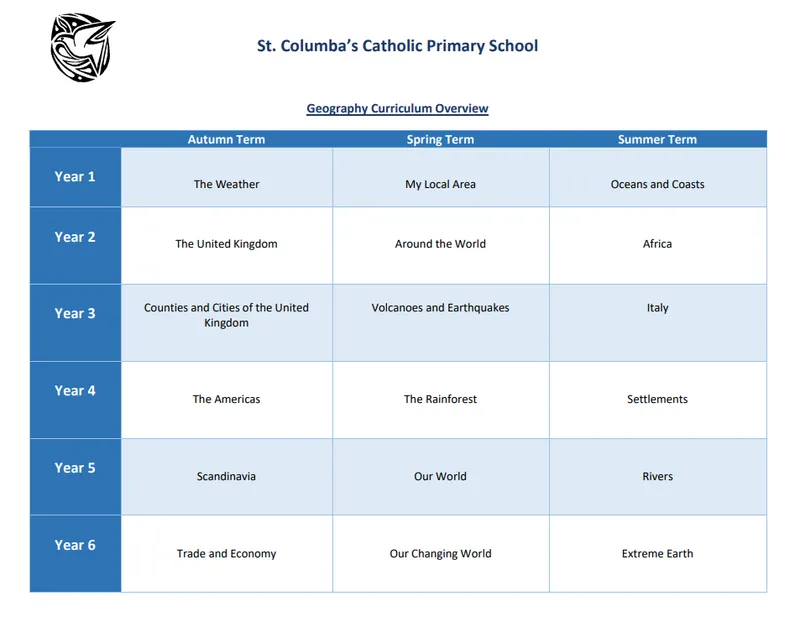
Geography Curriculum Overview