
LEARNING & DEVELOPMENT


At St. Columba’s we understand the need for all pupils to develop their scientific ability as a key component of their science curriculum as well as for all subjects. A good understanding of scientific knowledge and conceptual understanding helps to support pupils work across the curriculum.
Intent
We believe that a high quality science education provides the foundations for understanding the world through the specific disciplines of biology, chemistry and physics. Science has changed our lives and is vital to the world’s future prosperity, and all pupils should be taught essential aspects of the knowledge, methods, processes and uses of science. Through building up a body of key foundational knowledge and concepts, pupils should be encouraged to recognise the power of rational explanation and develop a sense of excitement and curiosity about natural phenomena. They should be encouraged to understand how science can be used to explain what is occurring, predict how things will behave, and analyse causes.
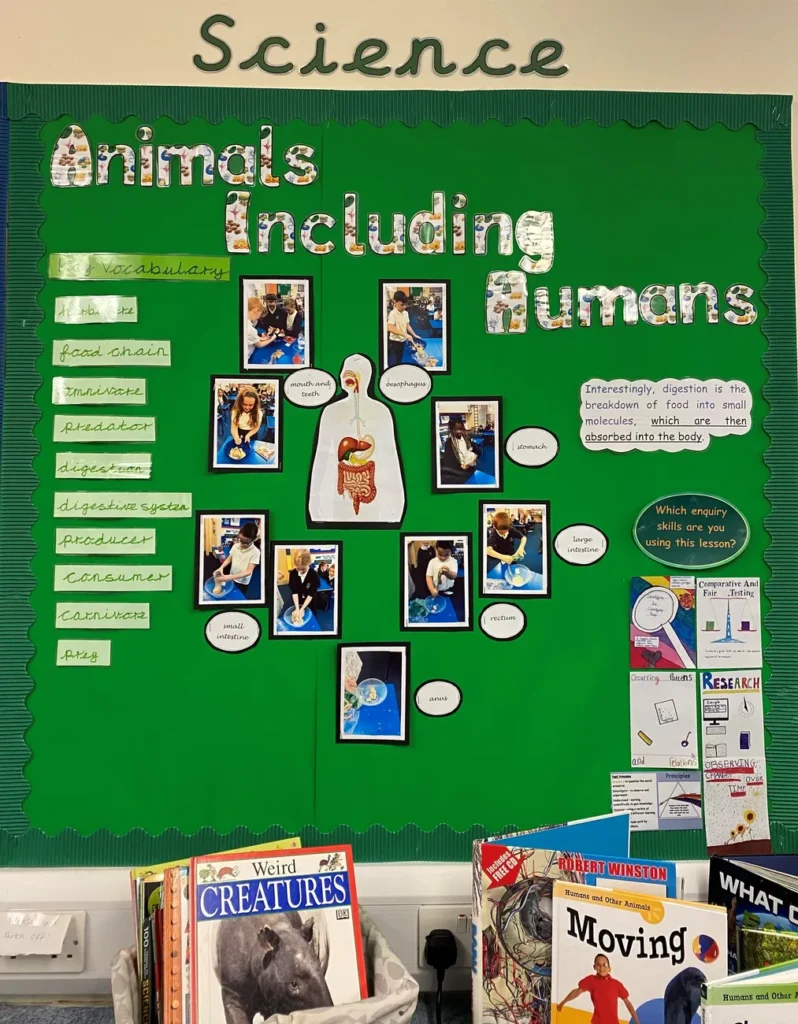
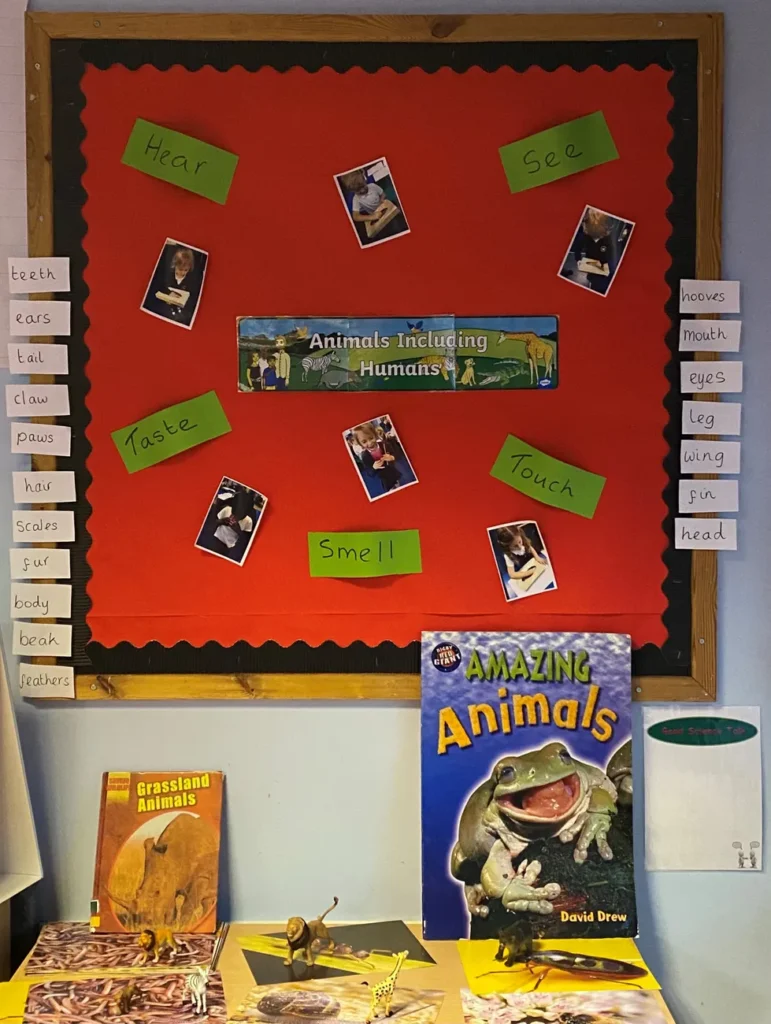
Science in our school is about developing children’s ideas and ways of working that enable them to make sense of the world in which they live through investigation, as well as using and applying process skills. Children are exposed to high quality teaching and learning experiences, which incorporate exploring their outdoor environment and locality, thus developing their scientific enquiry and investigative skills. They are exposed to scientific vocabulary, which aids children’s knowledge and understanding not only of the topic they are studying, but of the world around them. We intend to provide all children with a broad and balanced science curriculum.
Implementation
In ensuring high standards of teaching and learning in science, we implement a curriculum that is progressive throughout the whole school.
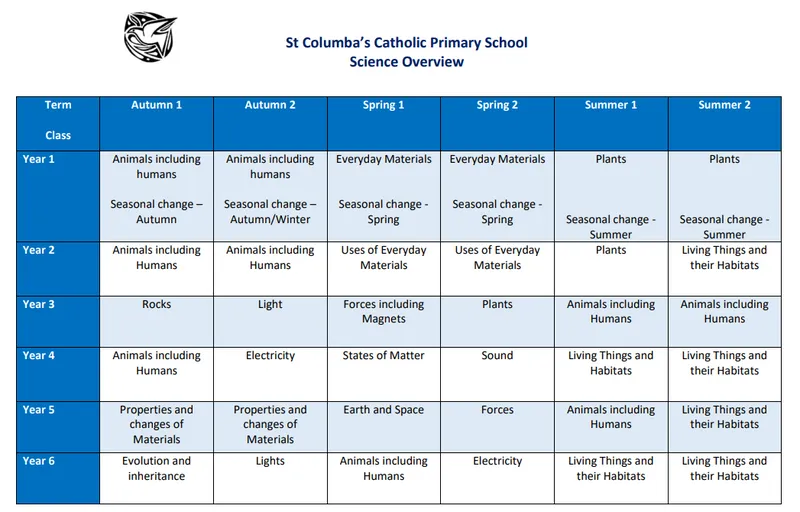
Planning for science is a process in which all teachers are involved to ensure that the school gives full coverage of, ‘The National Curriculum programmes of study for Science 2014’ and, ‘Understanding of the World’ in the Early Years Foundation Stage. At St. Columba’s science is taught in discrete units to ensure a full coverage of the National Curriculum and teaching involves adapting and extending the curriculum to match all pupils’ needs. Where possible, Science is linked to other subjects. Due to one form year groups in our school, Science units are taught on a year rolling programme. This ensures progression between year groups and guarantees topics are covered. We plan to incorporate opportunities to improve the children’s science capital where possible, by linking concepts to our locality, making links between science and future careers and by encouraging visits and talks from people using scientific skills in their jobs.
Science is taught consistently, once a week for up to two hours, but is discretely taught in many different contexts throughout all areas of the curriculum. For example, through English, i.e. biography of their class scientist.
At St. Columba’s we aspire to promote children’s independence therefore we have implemented assessment tasks at the end of each unit, where the children can show their knowledge and understanding through working scientifically. This allows children to plan, predict, test, record and evaluate. We have also developed science knowledge organisers to show clear progression and of the children’s new found knowledge and understanding.
Impact
The impact and measure of this is to ensure children not only acquire the appropriate age related knowledge linked to the science curriculum, but also skills which equip them to progress from their starting points, and within their everyday lives.
Pupil voice shows children across school enjoy science and their views formed our school science principles and ensured teaching and learning is explorative, causing awe and wonder which creates opportunities to discover, question and expand their knowledge and understanding. Progression is tracked through monitoring at the beginning, mid and end of the year, which allows children to be targeted in enquiry skill areas that they may have shown as making slow progress.
We have achieved the PSQM Award which has had a positive impact across school. It has brought a greater focus on investigations, enrichment and outdoor learning as well as ensuring we provide wider opportunities for our children.
The Award has had a great impact on teaching and learning, therefore expanding our children’s knowledge and understanding. This ensures that all types of enquiry skills are taught and that we have complete coverage of the National Curriculum.
Science Rationale

Our Curriculum Overview